
Unicoi Parole and Probation Compared
Parole and probation both allow a person to live in the community under rules, but they begin in different ways. Parole is conditional release from incarceration before the sentence expires. The Tennessee Board of Parole decides whether to grant it. Probation is part of a court sentence and may begin after a jail term or without a state-prison term. TDOC administers felony community supervision in either case. A notice that someone left Unicoi Jail (M) or Unicoi Annex (F) does not, by itself, prove parole or probation.
The distinction matters when verifying a released person. A court judgment is the source for probation terms. A Board decision is the source for a parole grant. TDOC maintains the active supervision assignment, while the public Felony Offender Information Lookup, or FOIL, may display a status of parole or probation. Final sentence expiration or discharge means active supervision has ended, though the court and TDOC records remain distinct.
| Record point | Parole | Probation |
|---|---|---|
| How it starts | Board-approved conditional release from incarceration | Court-ordered community sentence |
| Decision authority | Tennessee Board of Parole | Sentencing court |
| Day-to-day supervision | TDOC field office | TDOC for felony community supervision |
| Public person check | FOIL status, location, and hearing result | FOIL status and location, plus the court judgment |
- Parole
- Conditional release from confinement before sentence expiration.
- Probation
- A community-based sentence imposed by a court.
- Discharge
- The end of an active sentence or supervision term shown by the responsible authority.
- Absconder
- A person alleged to have stopped reporting or become unavailable to supervision.
Verify Unicoi Post-Release Supervision
FOIL is the practical public starting point for a current or former Tennessee felony offender. Search by TOMIS number when known because an identifier is safer than name alone. A matching detail may show supervision status, assigned location, sentence dates, release information, and parole hearing data. Read the fields together. An “inactive” status generally points to no active TDOC sentence or supervision in the public record, but it should be checked against the release information and source record.
A focused verification sequence keeps agencies in their proper roles:
- Open Tennessee FOIL and search by TOMIS number or a carefully matched name.
- Compare the name, birth information, identifier, status, and assigned location before drawing a conclusion.
- If status shows parole or probation, compare the assigned location with the TDOC field-office directory.
- Call the listed office with the TOMIS number and ask for public confirmation of active office assignment and reporting direction.
- Use the Unicoi court judgment for the sentence and FOIL for TDOC-maintained public status. Seek a TDOC record when formal proof is required.
Private case details may not be available. Conditions, residential information, health data, victim information, and internal risk records can be confidential. Asking only for public status and office assignment makes the request clear. A separate explanation of release and discharge records appears in the Unicoi County released-inmate search.
Unicoi Supervision Uses District 10
Unicoi County does not have a separate Erwin TDOC field office in the official directory. Unicoi and Washington Counties share District 10 in Johnson City. That office handles community-supervision routing, not county jail records or Board hearing decisions. A FOIL location should still be checked before travel because assignments can change, and the directory does not promise walk-in access or public access to a full case file.
TDOC District 10
Unicoi and Washington Counties
195 Freckles Court
Johnson City, TN 37601
Phone: 423-434-6800
Fax: 423-434-6830
The official TDOC field-office directory shows this shared assignment. Its captured directory view illustrates where Unicoi supervision calls are routed.
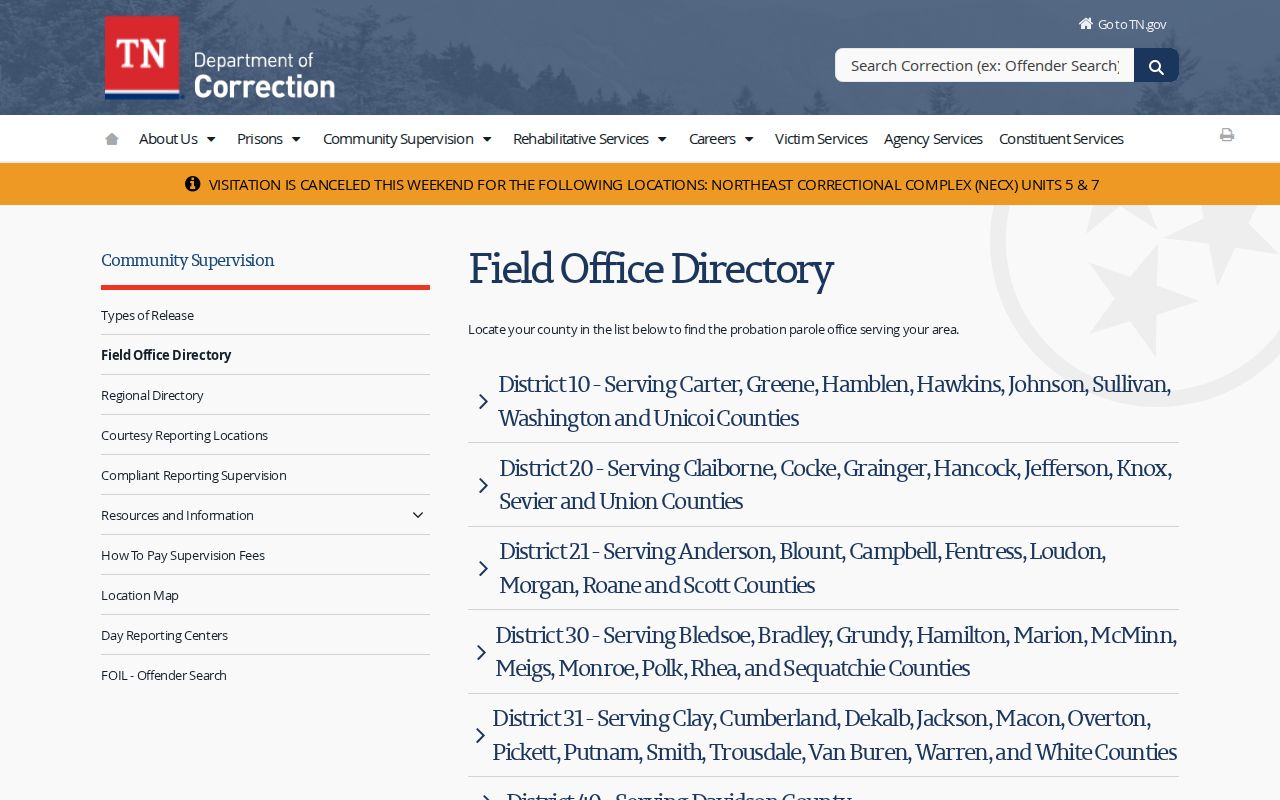
The Johnson City listing is a strong local cross-check, but the live FOIL assignment remains the person-level source. Call before making a trip.
Note: District 10 is a supervision office, while the Unicoi County Sheriff keeps local booking and physical-release records.
Unicoi Split-Confinement Reporting Rule
TDOC states that a probationer must report within 48 hours after placement on probation or release from split confinement. Split confinement means a sentence divided between a custody period and probation. The short reporting window makes the correct District 10 assignment important for a person leaving a Unicoi County jail. It is not safe to assume that an Erwin office exists or that a courthouse visit counts as reporting to TDOC.
The TDOC types-of-release page also distinguishes parole, probation, determinate release, community supervision for life, and mandatory reentry supervision. Each may place a person in the community with an active duty to report. Determinate release is a narrow statutory structure for certain one-to-two-year felony terms after the required service and process. Mandatory reentry supervision has its own eligibility rules for covered offenses committed on or after July 1, 2021.
Parole has a separate pre-release step. A Board grant does not complete the release. Conditions must be addressed and a probation/parole office must approve the release plan. A person can therefore have a favorable Board result while still confined. That gap is why physical release, active supervision, and hearing outcome should be verified separately.
Unicoi Parole Hearings and Results
The Tennessee Board of Parole hearings process publishes schedules for state prisons and county jails. The Board says schedules are refreshed each Monday, or Tuesday after a Monday holiday, and may change. Entries commonly give a facility, TOMIS number, name, hearing type, and date. The schedule shows a planned event, not a durable decision or proof that a person left custody.
A hearing officer hears the matter and makes a nonbinding recommendation. Board members can adopt, modify, or reject it. Public results may include grant, deny, or defer. The Board explains that the number of concurring votes varies by matter: three for some offenses, four for most violent conviction offenses, and two to revoke parole. FOIL can show a person-level parole hearing date and result after the event.
The official materials cover initial and review hearings, preliminary and final revocation, custodial hearings, rescission, time setting, and appeal-related matters. Preliminary revocation addresses probable cause. A final revocation can revoke or reinstate supervision. Rescission can undo a parole grant before release, which again separates a Board result from physical departure.
The official hearing schedules provide the calendar view shown below.
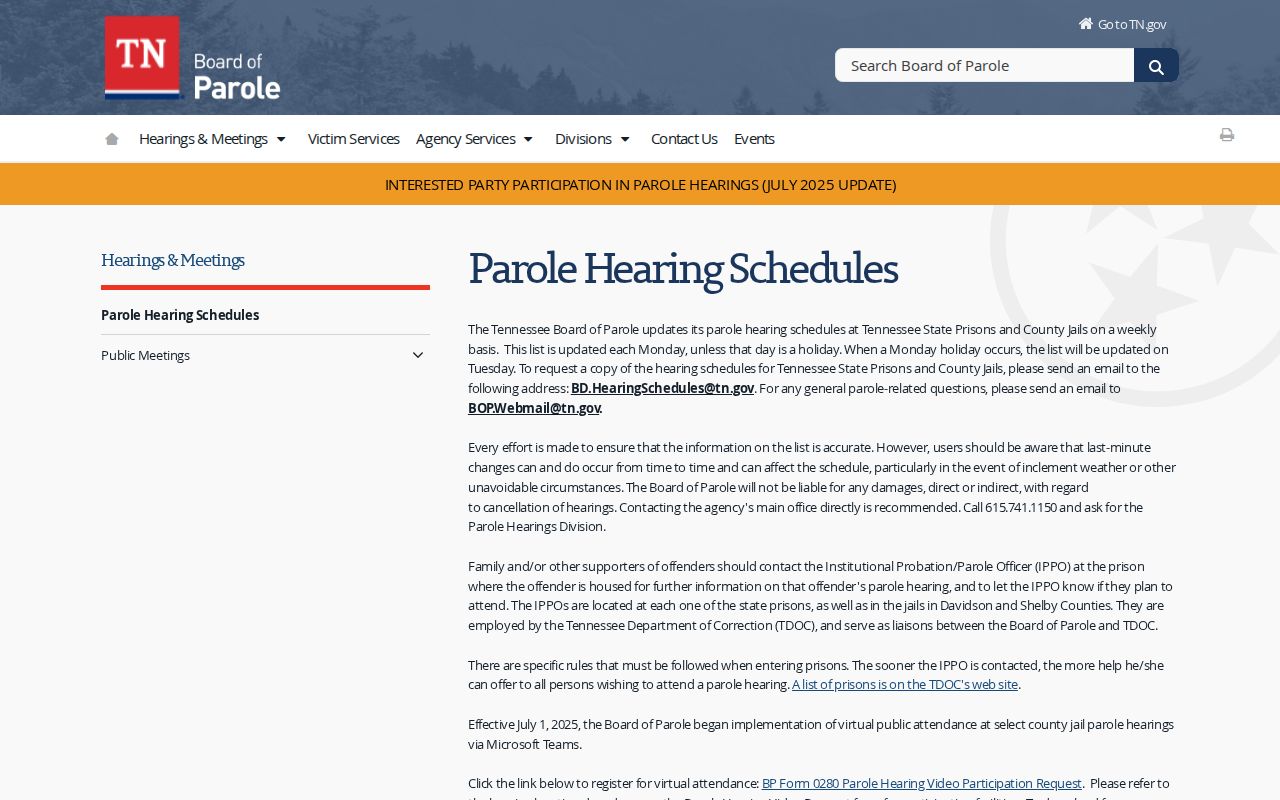
After the scheduled date, FOIL is the better public path for the posted person-level result. The Board remains the authority for process questions.
Unicoi Parole Decision Appeals
A parole decision appeal is limited. Under T.C.A. § 40-28-105(d)(11) and the Board’s process, a request must be filed no later than 45 days after the offender receives the final decision. The permitted grounds are significant new information that was unavailable at the hearing, substantiated misconduct by the hearing official, or significant procedural error. Mere disagreement with the result is not listed as a ground.
If the Board grants an appeal, the case is placed on the next available docket. That means another procedural step, not automatic parole or release. The Board’s parole decision appeal page should be checked for the current filing instructions and deadline details. For an actual departure, compare the FOIL status, TDOC release record, and releasing facility record.
Note: A Board schedule establishes a planned hearing; it does not establish a final result, active supervision assignment, or physical release.
Unicoi Supervision Violations and Warrants
Supervision conditions are case specific. They can involve reporting, approved residence or travel, court-ordered programs, and compliance with lawful instructions. Public FOIL fields do not expose every condition. A suspected breach can lead to an allegation, warrant, revocation process, or other response, but an allegation is not a new conviction. The court and Board procedures control the result.
No reliable official public Unicoi County absconder list was found. FOIL may display public supervision status, yet silence is not warrant clearance. Direct warrant questions to the relevant court or law-enforcement agency. Direct active assignment questions to FOIL and District 10. VINE custody notifications can help track a later custody event, but they do not replace a warrant check or supervision record.
A transfer also needs care. Release from one custodian to another county or TDOC is not freedom in the community. If VINE shows more than one agency record, match each episode and register for the relevant custody event where offered. This avoids treating a transfer alert as the end of confinement.
How Unicoi Supervision Ends
Post-release supervision ends through the authority that controls the sentence, not merely because a public status disappears. Sentence expiration, a formal discharge, a court order, or a Board action may be relevant. FOIL can show an inactive public status, but the release information and underlying records should be read with it. A person who completed parole is different from one whose parole was revoked, and a person discharged from probation is different from one transferred to another office.
For formal TDOC history, use the archived-record request route. Provide the full name, TOMIS number, and date of birth through the approved channel. Ask for the release or discharge date and type, sentence expiration, supervision status, release authorization, and movement record. A FOIL screen is convenient public evidence, but it is not a certified TDOC record.
When records conflict, send the issue to the office that owns the field. The Sheriff controls the local booking and physical-release event. The court owns its judgment and later orders. TDOC owns the state supervision and sentence record. This division preserves the difference between leaving a Unicoi jail, beginning supervision, and completing the sentence.