
Unicoi Eligibility and Exit Dates
Tennessee’s public FOIL record uses the label Release Eligibility Date. That is not a guaranteed physical exit date. For a parole-eligible sentence, it marks the point when a person may become eligible for release consideration under the judgment and governing statute. The Tennessee Board of Parole may grant, deny, or defer parole. Even a grant can precede release-plan approval, sentence review, and resolution of a detainer.
A sentence end date is another concept. It concerns the calculated term. A scheduled release may reflect an agency’s current plan. The actual release is the documented event when the person leaves that custodian. Someone may leave Unicoi Jail (M) on transfer to TDOC and still be incarcerated. Likewise, a state prisoner can be released by TDOC to another county hold without being free in the community.
A pretrial detainee usually has no computed sentence release date. Bond, dismissal, court action, case disposition, and other holds determine the outcome. The court can explain its order, while the Sheriff records the physical departure. A sentenced county inmate has a calculation, but it is maintained through the judgment, jail credit, authorized credits, and holds rather than FOIL unless TDOC also has the case.
Find a Unicoi Release Date
The right search route depends on custody. FOIL covers current and former felony offenders in TDOC custody or supervision. It is not the county jail’s booking system. For a person serving a local sentence at either Unicoi building, the Sheriff and the court record are the direct sources. For a state prisoner, FOIL and TDOC sentence records carry the public and formal state calculation.
Use this order to avoid mixing an eligibility field with a release event:
- Identify whether the person is pretrial, serving a county sentence, in TDOC custody, on supervision, or held by another agency.
- For a TDOC case, search FOIL by TOMIS number when possible and open the exact matching detail.
- Read supervision status, assigned location, sentence begin and end dates, Release Eligibility Date, parole hearing fields, and active sentence information together.
- For a county sentence, obtain the judgment from the Unicoi court and ask the Sheriff which jail credit, authorized credits, and holds control the physical release.
- Close to the date, recheck the live status and request the final release record from the agency that held the person.
Name-only matches can be wrong. FOIL permits name and identifier searching, with optional identity filters. Compare birth information, TOMIS ID, State ID, aliases, and descriptors only as needed to distinguish the correct record. The full county search path for a person whose jail entry has vanished is available through the Unicoi County released-inmate lookup.
Unicoi FOIL Release Eligibility Date
FOIL’s public detail is useful because it places sentence, hearing, and status fields beside one another. The key fields answer different questions. “Sentence End Date” concerns the sentence calculation. “Release Eligibility Date” concerns the point at which the governing sentence structure permits eligibility. “Parole Hearing Date” and “Parole Hearing Result” concern the Board process. “Supervision Status” and “Assigned Location” describe the public current state.
| FOIL field | What it can establish | What it cannot establish alone |
|---|---|---|
| Release Eligibility Date | Eligibility point under the sentence and law | A guaranteed exit or parole grant |
| Sentence End Date | TDOC sentence-calculation field | The time and place of physical departure |
| Parole Hearing Result | Posted Board outcome | Completion of release planning |
| Supervision Status | Public parole, probation, inactive, or custody status | The full confidential case file |
The FOIL detail interface is the source represented in this captured view. A useful record view depends on a valid search session and an accurately matched person.
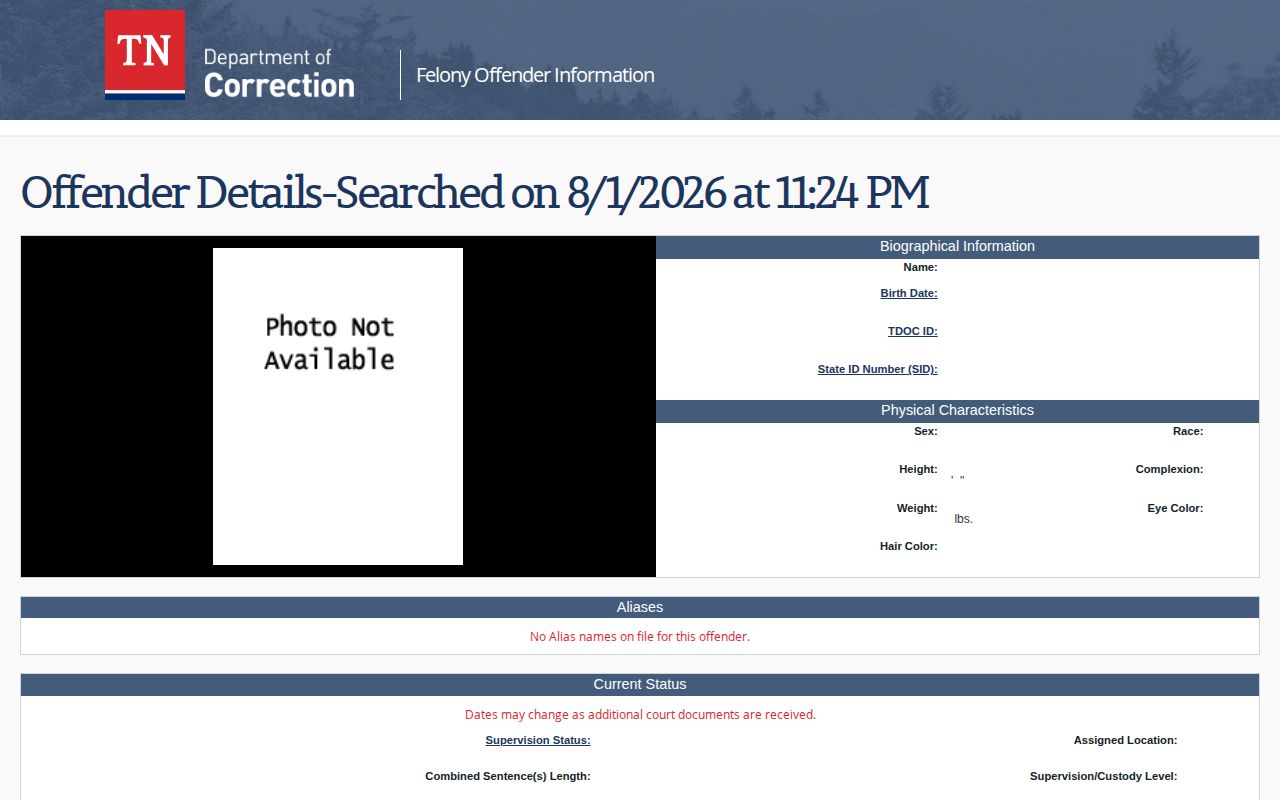
The field labels should be saved with the retrieval date. FOIL warns that dates may change as more court documents arrive, so a screenshot is a point-in-time reference rather than a promise.
Tennessee Rules Shape Unicoi Dates
T.C.A. § 40-35-501 contains several release-eligibility structures tied to the offense and sentence. The controlling facts include the exact conviction, offense date, offender range or classification, the judgment’s eligibility notation, and the applicable statutory subsection. Consecutive terms must be handled differently from concurrent terms. Later law can also matter.
No single percentage describes all Tennessee sentences. The familiar “85 percent” phrase applies only to particular statutory structures. Under relevant versions of § 40-35-501, some listed violent offenses require service of the full term less allowable credits, with credits capped so they cannot cut service by more than 15 percent. Other offenses and dates use different rules or may be non-parole eligible.
For certain enumerated offenses committed on or after July 1, 2022, Tennessee truth-in-sentencing provisions require 100 percent service under the applicable subsection and limit how credits affect the term. Aggravated robbery rules also vary with the offense date. Older or general regimes can involve eligibility percentages such as 20, 30, 35, 45, or 60 percent. Those figures are not a menu for a web calculation. Offense-specific and later provisions can override them.
The TDOC policy repository supplies the current sentence-management context shown below.
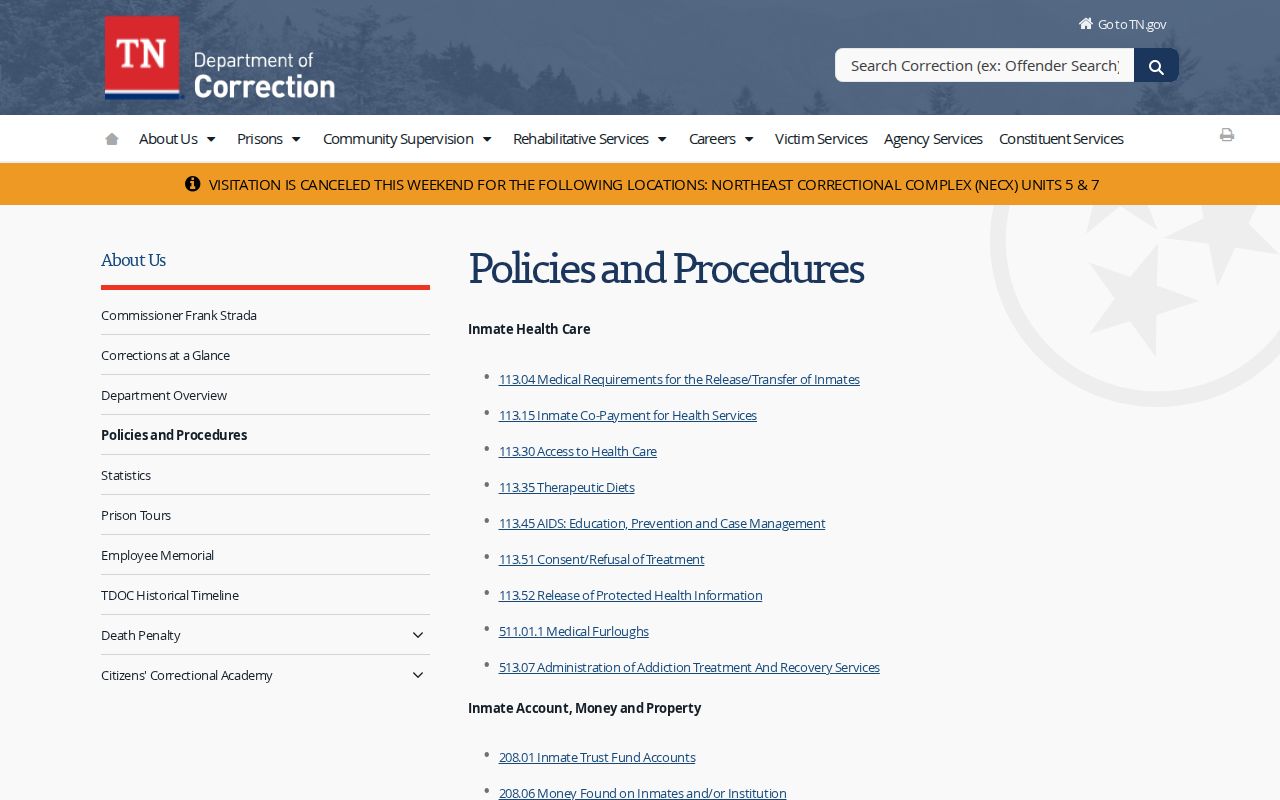
The governing statute, current policy, judgment, and TDOC calculation must be read together. Sentence length alone cannot produce a dependable release date.
Unicoi Release Credits Need Context
Sentence-reduction credits under T.C.A. §§ 41-21-229 and 41-21-236 can affect sentence administration when the specific sentence allows them. Credits may be earned, withheld, forfeited, restored, or limited. Program participation and conduct can matter. A credit that changes one calculation does not always advance parole eligibility or sentence expiration in the same way.
TDOC is the official state sentence timekeeper. The Board of Parole does not independently choose the eligibility date. The Board acts when the law and certified sentence make parole available. A favorable hearing result is therefore one event within a longer process, not a replacement for TDOC’s computation.
- Jail credit
- Time credited by the judgment for qualifying confinement before or during the sentence.
- Sentence-reduction credit
- A credit administered under governing law and policy, subject to limits.
- Consecutive sentence
- A term served after another term rather than at the same time.
- Detainer
- A request or hold from another authority that can prevent community release.
Escape time, disciplinary events, a sentence amendment, and late court paperwork can alter the displayed result. The safe question is not “How much time comes off?” It is “Which law and sentence field controls this person’s current date?”
Note: Credits may change a calculation without making a person immediately eligible for parole, discharge, or physical release.
Unicoi County Jail Date Limits
For a sentence served in a Unicoi County jail, the Sheriff calculates physical release from the court judgment, jail credit, authorized local or state credits, and any holds. The official county page does not publish a local good-time policy. It also provides no weekend or holiday release rule. That gap makes arithmetic from a sentence date especially unreliable.
Ask the Sheriff for the written sentence-computation policy and the person’s booking-and-release record. Ask the Circuit Court Clerk for the judgment, sentence, credit stated in the order, and later amendments. If a displayed end date falls on Sunday, there is no researched basis to assume release will occur Friday. Staff must confirm whether a policy or court order changes the actual event.
Unicoi County Sheriff’s Department
1570 Jackson Love Highway
Erwin, TN 37650
Phone: 423-743-1864
Administrative hours: Monday-Friday, 8:30 a.m.-4:30 p.m.
Ask staff to identify whether the relevant record belongs to Unicoi Jail (M) or Unicoi Annex (F). A move between the two buildings is not a release. An outside transfer also means the person left the local jail without necessarily leaving custody.
Why Unicoi Release Dates Change
A release date can move because the source documents or legal status change. FOIL specifically warns that new court documents can affect its dates. The change may be routine correction rather than a new event. Each factor should be traced to the agency responsible for it.
| Factor | Possible effect | Best verification source |
|---|---|---|
| New or corrected judgment | Changes sentence structure, credits, or dates | Court and TDOC |
| Consecutive or concurrent terms | Changes how multiple sentences combine | Judgment and TDOC computation |
| Credits or discipline | Earns, withholds, forfeits, restores, or limits credit | TDOC or Sheriff under controlling policy |
| Detainer or hold | Prevents community release or causes transfer | Holding and receiving agencies |
| Parole decision | Grants, denies, or defers conditional release consideration | Board result and FOIL |
| Release-plan approval | Can delay departure after a parole grant | TDOC supervision office |
A parole grant does not cancel a separate hold. A VINE notice from one custodian does not prove another agency released the person. The current status and final event record remain essential.
Confirm Unicoi Actual Release Dates
Near an expected date, repeat the FOIL check for a TDOC case or call the Sheriff for a local case. Record the date and exact field label seen. Then ask whether it is an eligibility date, sentence end, planned release, or completed event. For formal TDOC history, use the archived-record request and ask for release authorization, sentence computation or release summary, movement record, and discharge documentation.
VINELink can provide a prospective custody-event alert where the agency and event are offered. The Unicoi VINE inmate check explains how to match a record and register. An alert should trigger a fresh agency check. It does not certify the court judgment or rule out another hold.
Keep the three records separate. The court owns the judgment. TDOC or the Sheriff calculates the sentence under its authority. The holding agency records physical release. This approach handles Unicoi County’s lack of a published local calculation policy without inventing a date, and it preserves the crucial difference between becoming eligible and actually walking out.